A few weeks ago, I went to a routine doctor’s appointment.
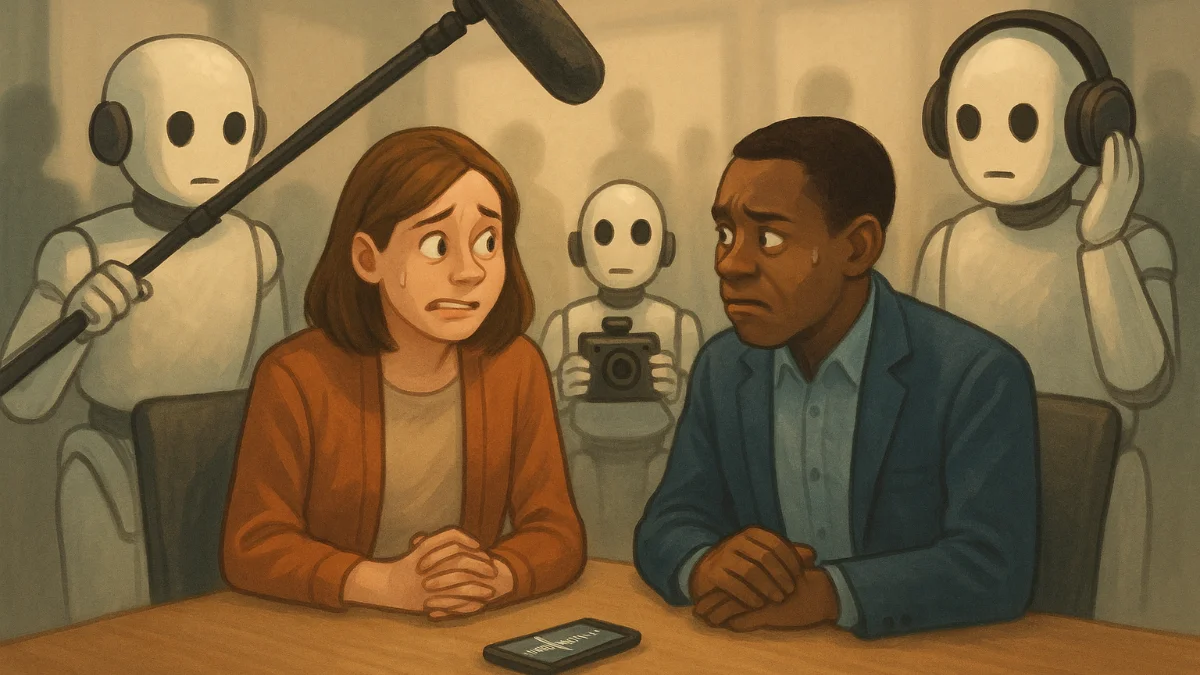
The doctor walked in, said hello, pulled out their phone, placed it on the desk, and started an AI transcription app. No explanation. No consent check. Just efficiency in motion.
I was not personally upset. I understood the convenience. Documentation is a burden, and transcription tools can genuinely help professionals do their jobs better.
But in that moment, I had no practical way to object.
That detail matters more than it seems. Because it captures exactly how AI transcription is entering nonprofit work. Quietly. Asymmetrically. With good intentions, but without a pause to consider who actually holds power in the room.
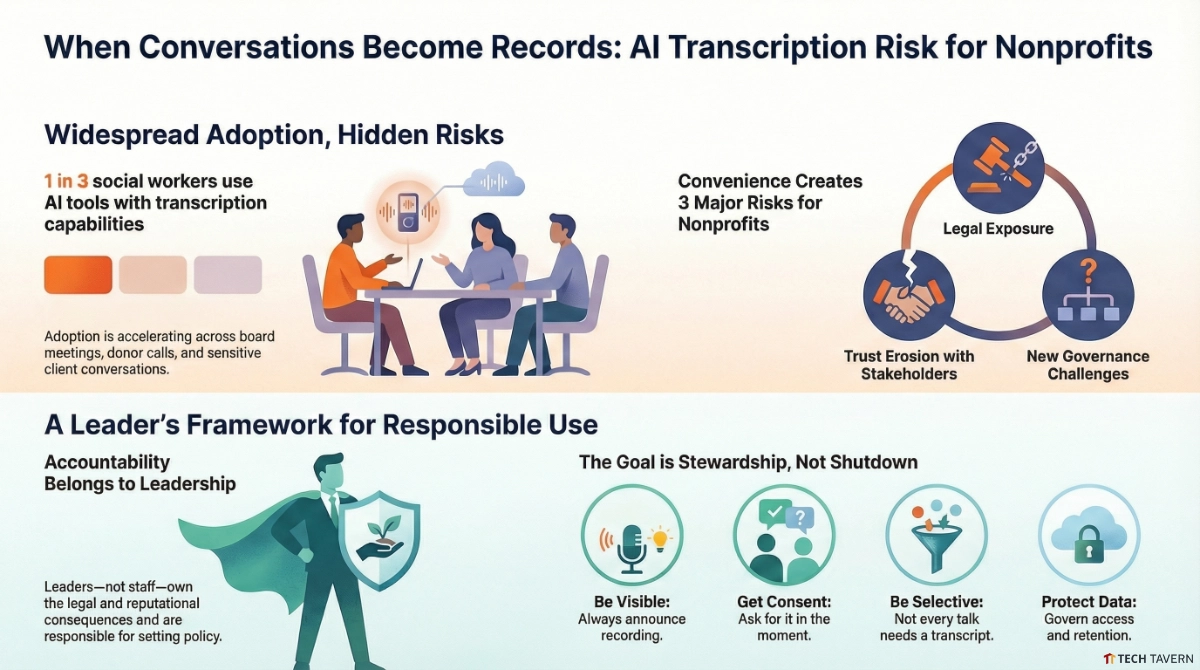
For nonprofit leaders, the specific ways AI transcription creates risk are though Legal exposure, Trust erosion, and Governance blind spots.
That is the lens I want you to read this article through.
Transcription Is Widespread, Especially in Nonprofits
AI transcription is no longer niche. It is already embedded in nonprofit and public sector work.
Recent research shows that roughly one third of social workers report using generative AI tools with transcription capabilities in their daily work. Popular services like Otter report tens of millions of recorded meetings across nonprofits, universities, healthcare, and government. Platforms like Zoom, Microsoft Teams, and Google Meet now offer transcription and summaries by default.
Adoption is accelerating globally. In Latin America, surveys show over 80 percent of professionals expect generative AI to be integrated into their work, even as nearly half cite privacy and confidentiality concerns.
This matters because transcription is not happening at the margins. It is happening in board meetings, donor calls, staff check ins, client conversations, and community listening sessions.
Which means it deserves the same governance attention as any other AI service.
The Baseline Risk Still Applies
Everything discussed in Part 1 and Part 2 of this series applies here.
AI transcription carries the same core risks as other AI tools. That includes privacy obligations, data protection requirements, account type concerns, and any applicable special protections like HIPAA or contractual confidentiality duties.
If a conversation includes protected health information, donor data, or sensitive client context, transcription does not make that safer.
Recording adds an additional layer of risk that changes the nature of the data itself.
Spoken conversations are ephemeral by design. Transcription makes them persistent, searchable, and portable. That shift alone changes how stewardship must work.
Recording Changes the Conversation
Transcription does more than capture words. It alters behavior.
People speak more freely than they write. They share uncertainty, emotion, and context that would never appear in an email or document. Once recorded, that moment becomes a durable artifact.
Searchability compounds this effect. A comment that felt harmless in a live conversation can be surfaced months later, out of context, by someone who was never in the room. AI summaries amplify this further by collapsing nuance into simplified takeaways that may carry unintended meaning.
This changes power dynamics. It changes trust. And it raises governance questions most organizations have not fully confronted yet.
Legal Exposure Is Real and Emerging Quickly
I am not a lawyer, and this is not legal advice. But every good data steward should understand the basic risks and how to manage them.
In the United States, recording laws vary by state. Some allow one party to consent. Others require everyone on the call to consent. When meetings span multiple states, the safest assumption is all party consent.
This is not hypothetical. In 2025, lawsuits emerged alleging unlawful recording tied directly to AI transcription tools when participants were not adequately informed. These cases surfaced quickly, before most organizations realized there was even exposure.
In Europe, the bar is higher. Under GDPR, voice recordings and transcripts are personal data. Consent must be informed, explicit, and revocable. Participants also have rights to access and deletion.
Latin American privacy regimes follow similar principles, with increasing enforcement and strong cultural expectations around consent and dignity in recorded conversations.
Here is the leadership reality that often goes unsaid.
These risks do not sit with individual staff members. They sit with organizational leadership.
Legal exposure, reputational damage, and governance failures are not IT problems. They are executive responsibilities.
Trust Erosion Happens Even Without a Breach
You do not need a lawsuit or data breach to lose trust.
- A volunteer discovering their comments were transcribed without their knowledge.
- A client realizing an intake call was recorded by an AI service.
- A community partner learning their words were summarized and shared internally.
Even when technically legal, these moments feel like surveillance to the people experiencing them. In nonprofits, trust is not a soft value. It is core infrastructure.
Power imbalance makes this worse. Beneficiaries, volunteers, and junior staff may not feel able to object, even when uncomfortable. Silence should never be mistaken for consent.
Governance Blind Spots Multiply Over Time
Transcription introduces governance complexity that many organizations have not yet internalized.
- How long are transcripts retained?
- Who can access them later?
- Are summaries stored separately from raw transcripts?
- Are they searchable across meetings?
- Can they be reused or analyzed in the future?
Each answer creates new obligations.
Secondary use risk is real. Data captured for convenience today can be repurposed tomorrow in ways participants never agreed to. Searchability increases institutional power while quietly shifting expectations for everyone else in the room.
Translation Extends the Same Risk Surface
Real time translation is an extraordinary capability, especially for global nonprofits. But it does not reduce privacy risk. It extends it.
Translation requires transcription first. The same audio is captured and processed. Participants may not realize that enabling captions or translation still means an AI system is listening.
There is also a dignity dimension. Seeing one’s words instantly translated and displayed can feel very different than speaking them aloud. That expectation deserves explicit acknowledgment.
What Responsibility You Personally Own as a Leader
If you are an Executive or senior leader, this is the line of accountability that belongs to you.
- You own whether AI transcription is allowed in your organization.
- You own where it is appropriate and where it is not.
- You own how consent is obtained, and whether declining is truly safe.
- You own how long transcripts and summaries exist, and who can access them later.
- You own how secondary use is prevented, intentionally or accidentally.
- You own the reputational and legal consequences if trust is broken.
You can delegate configuration. You can delegate policy drafting. You cannot delegate accountability.
That is not a burden. It is the role.
The Goal Is Stewardship, Not Shutdown
The answer is not to ban transcription tools.
These tools can improve accessibility, reduce burnout, and help small teams operate more effectively. Shutting them down would be a mistake.
The goal is intentional stewardship.
For leaders, that means setting clear principles rather than relying on informal norms:
- Visibility: Be explicit when transcription or recording is used. Say it out loud.
- Consent: Ask in the moment, not just in policy documents.
- Selectivity: Not every conversation should be recorded. Some should remain ephemeral by design.
- Protection: Use enterprise grade accounts with clear data protections and contractual safeguards.
- Governance: Define retention, access, and secondary use rules before data accumulates.
Leadership is not about slowing progress. It is about guiding it responsibly.
Most people using transcription tools are trying to do their jobs better. Our responsibility as leaders is to make sure convenience does not outrun consent, and efficiency does not erode trust.
If there is AI in the room, everyone deserves to know it is there.