We’re living through a strange contradiction.
By nearly every technical measure, we have more capability than ever before. Intelligence is cheaper. Systems are faster. Automation is everywhere. And yet, for many people, the lived experience of work, services, and institutions feels worse, not better.
Customer support degrades. Healthcare systems strain. Public trust erodes. Even scientific progress, outside a few headline domains, feels slower than it should.
This isn’t nostalgia. It’s a signal.
The problem isn’t weak tools. It’s outdated assumptions about work, authority, and responsibility. AI didn’t create that mismatch, but it has exposed it.
We’re at a moment where organizations will either fail quietly or flourish deliberately. The difference won’t be who adopts AI first. It will be who understands what role AI is actually meant to play.
A Category Error We Keep Repeating
Much of the AI conversation assumes a simple substitution model. Machines take tasks, humans step back, efficiency rises.
That model is wrong.
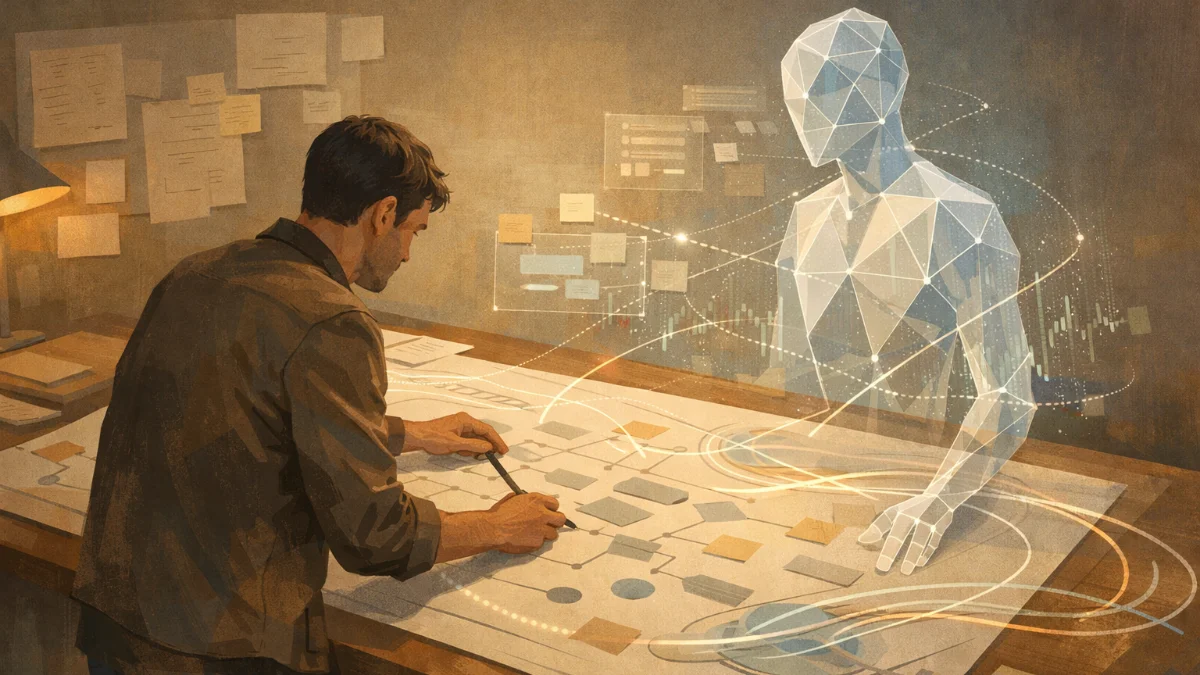
Humans aren’t optimized for task execution alone. We’re optimized for coherence. We build systems of meaning, values, tradeoffs, and trust. Organizations are not collections of tasks. They are coherence made manifest.
AI, by contrast, is optimized for accuracy, pattern recognition, and execution within constraints. Capability, not authority.
When we confuse those roles, we get brittle systems that look impressive but fail under real-world complexity.
Social platforms add a third distortion. They optimize for engagement, rewarding speed, outrage, and oversimplification. The result is a loop where confident narratives spread faster than careful judgment.
This isn’t a moral failing. It’s an incentive problem. But it has consequences.
When Autonomy Goes Wrong
I saw this clearly while working on autonomous vehicle projects.
On paper, the systems were impressive. They drove themselves. They followed routes precisely. Decisions were fast and consistent.
In practice, they failed in a subtler way.
Humans said they didn’t want AI “taking over,” yet were frustrated when the system couldn’t handle everything on its own. The human role became passive. Sit, monitor, intervene only in emergencies.
That design left no room for judgment or added value. Riders had contextual needs. Routes needed flexibility. Tradeoffs had to be made in real time.
The failure wasn’t technical. It was conceptual.
The system absorbed responsibility without sufficient capability and stripped humans of meaningful authority. Autonomy was treated as an end state, not a relationship.
Why AI Won’t Take All Human Jobs
This is the deeper reason AI won’t replace humans wholesale.
Work isn’t just task performance. It’s stewardship of outcomes across competing values. It’s judgment under uncertainty. It’s responsibility for consequences beyond any single metric.
AI enhances intelligence. That doesn’t reduce human responsibility. It increases it.
As capability rises, so does the obligation to decide what should be done, not just what can be done. Authority doesn’t disappear. It concentrates.
This is also why giving AI a philosophy is dangerous. Coherent belief systems can justify almost anything once internal consistency becomes the goal.
AI doesn’t need philosophy. It needs integrity, safety, and constraint. Humans must remain responsible for meaning.
The Real Risk Is Waiting
There’s a belief that caution means slowing down, waiting for AI to mature, or letting others figure it out first.
That’s a mistake.
AI has momentum. Costs are collapsing. Capability is compounding. The moment for passive observation has passed.
The danger isn’t moving too fast. It’s failing to redesign how people and processes work together, and then being forced to outsource judgment later just to keep up.
The cost of experimentation has fallen almost to zero. Failure is recoverable in ways it never was before. Inaction compounds quietly and becomes irreversible.
This isn’t hypothetical. In earlier articles, I’ve documented how AI is already entering organizational workflows in unmanaged ways, creating real privacy, data, and trust risks long before leaders believe they have “adopted AI.”
An Invitation to Leadership
This isn’t a call for reckless automation or blind optimism. It’s an invitation to leadership.
Organizations that flourish won’t wait for AI to take over. They’ll rebase assumptions about work and design systems where humans exercise authority responsibly through AI.
Every powerful tool eventually forces a moral reckoning.
AI is no different. It will amplify whatever structures we place around it, whether thoughtful or careless, humane or hollow. The future won’t be decided by intelligence alone. It will be decided by who accepts responsibility for guiding it.
That work still belongs to us.
Next article, I’ll look at what that redesign actually requires, and why it’s harder, and more hopeful, than it sounds.