Google's data center in Council Bluffs, Iowa consumed roughly 21% of the city's water supply in 2023. That number has done more to put water infrastructure back into public conversation than fifty years of slow failure ever managed. And it's still the wrong number to be alarmed about.
U.S. data centers consume about 17 billion gallons of water annually. American golf courses consume about 500 billion. The comparison is about scale, not equivalence. Golf course water is mostly non-potable irrigation, while data center water is often pulled from municipal potable supply, which is why the local picture can look so different from the aggregate. The AI water bill is acute in a few specific places and modest in total. The parts of the system that are actually failing were failing decades before any data center showed up. What AI has done is force the conversation. Without it, the same crisis would have continued the way it has since the 1970s, slowly and out of sight. The answer isn't to ban datacenters, but to fix what's already broken, and AI's water demand becomes a planning detail.
This is the companion to my previous position paper on hyperscaling the U.S. electric grid, and like that one, it's part of a longer piece I'm working on about what AI is actually going to cost us. The cost of AI isn't the cost of AI. It's the bill coming due on a century of underinvestment. Compute is the headline. Infrastructure is the story.
My education is in environmental microbiology with a focus on groundwater bioremediation, so I've spent more time than is healthy thinking about how water moves through a community and how easily that path gets broken. Water systems are one of the most undervalued ways to build public wealth we have. The universal prosperity promise of AI only pays out if we treat water, power, and compute as a single investment. That's what this piece is really about.
A system built for a different country
David Sedlak's history of American water infrastructure, Water 4.0, tells the same story across three centuries. We've only built after a visible catastrophe forced our hand. Population overwhelm in the 1800s. Typhoid epidemics in the early 1900s. Post-WWII river pollution that gave us the Clean Water Act in the 1970s. We're now in the fourth crisis, and Sedlak names it cleanly. "Our aging drinking water systems are not ready for the less forgiving future that will prevail in an era of climate change and inadequate pollution regulations."
Most of the network was built during the second and third of those crises. A lot of it is 60 to 120 years old now, well past its intended service life. The country logs about 240,000 water main breaks a year. PFAS (per- and polyfluoroalkyl substances), the "forever chemicals" that don't break down in the environment, contaminates the water supply for roughly a quarter of the country. Flint is the canonical recent story, but the lesson from Flint isn't that something rare happened there. The slower, distributed version of the same failure has been running across hundreds of communities for decades.
There's a quieter problem on top of all that. One-third of the workforce that actually knows how to run this stuff is eligible to retire inside ten years. You can't replace that with a procurement line item, and you can't train it on the same timeline as a capital project.
A lot of people have already given up. Chinatown still lands ninety years after the Owens Valley aqueduct it's based on, because the institutional dynamics it satirizes haven't meaningfully improved. We're not going to bottle our way out of this, and we're not going to litigate our way out either. We solve this on the ground, with options that have become mature enough to deploy at scale in recent years.
Why governance makes the problem hard
The U.S. water network isn't really a network. It's a patchwork of roughly 50,000 separate community water systems, layered under fragmented state regulators and tangled together with tribal compacts, agricultural districts, and interstate compacts that often actively block coordinated planning. Unlike most peer countries, no single authority is in charge of "the water system" as a coherent thing.
The real cost lives in rights and permits, not in pipes. The Colorado River compact has been in active dispute since the 1920s and still constrains growth across the entire Southwest. Local political opposition to wastewater recycling routinely adds years to deployment even when the engineering is settled science. And federal R&D money is tiny against the scale of the problem. The DOE's most recent investment in desalination and water reuse was $9 million across 12 projects. That's a real signal, and a welcome one, but it's small money against a $625 billion gap.
You end up with the same story across the country. Communities know what they need. The engineering exists. The institutional friction makes it nearly impossible to deploy on the timeline the demand actually requires.
The demand collision: why "now" feels acute
The reason things feel acute right now is that two slow problems collided with a fast one. The long-distance import sources we'd been counting on were going to slip eventually. Climate stress on supply was knowable. The demand surge from data centers and reshored manufacturing wasn't on anyone's planning curve. All three hit at once, and broke an assumption planners had quietly leaned on for decades.
| Factor | 2010 projection | 2026 reality |
|---|---|---|
| Long-distance imports (Colorado River, etc.) | Stable through 2030 | Reservoirs at critical lows since 2000; Atlanta, Tampa, and Charlotte facing supply security questions |
| Climate stress on supply | Manageable | Persistent drought across ~40% of the U.S. mainland; coastal tidal flooding up to 10x more frequent than 50 years ago |
| Data centers and reshoring | Marginal share of municipal water | Nearly two-thirds of new U.S. data centers built in high water-stress areas since 2022; a single facility can consume 21% of a city's water |
From 2000 to 2020, U.S. per capita water use was actually declining, thanks to efficiency gains in appliances, irrigation, and industrial cooling. Planners assumed that offset would carry through 2030 and chose not to invest in alternative supply. Climate-driven supply degradation and demand surge from reshored manufacturing and data centers ended that era roughly five years ahead of schedule.
This is the part I want people to understand clearly. The AI boom isn't the cause of the water crisis. It's the trigger that exposed it. The system was this fragile before any data center showed up. In 2023, Google's data center in Council Bluffs, Iowa consumed roughly 980 million gallons of water, about 21% of the city's total use. The reason a single facility can take that share isn't that the facility is uniquely thirsty. It's that the city's system was built for a population and an economy that no longer exists, and nobody funded the upgrade.
The fast-path solution: hyperscale recycling
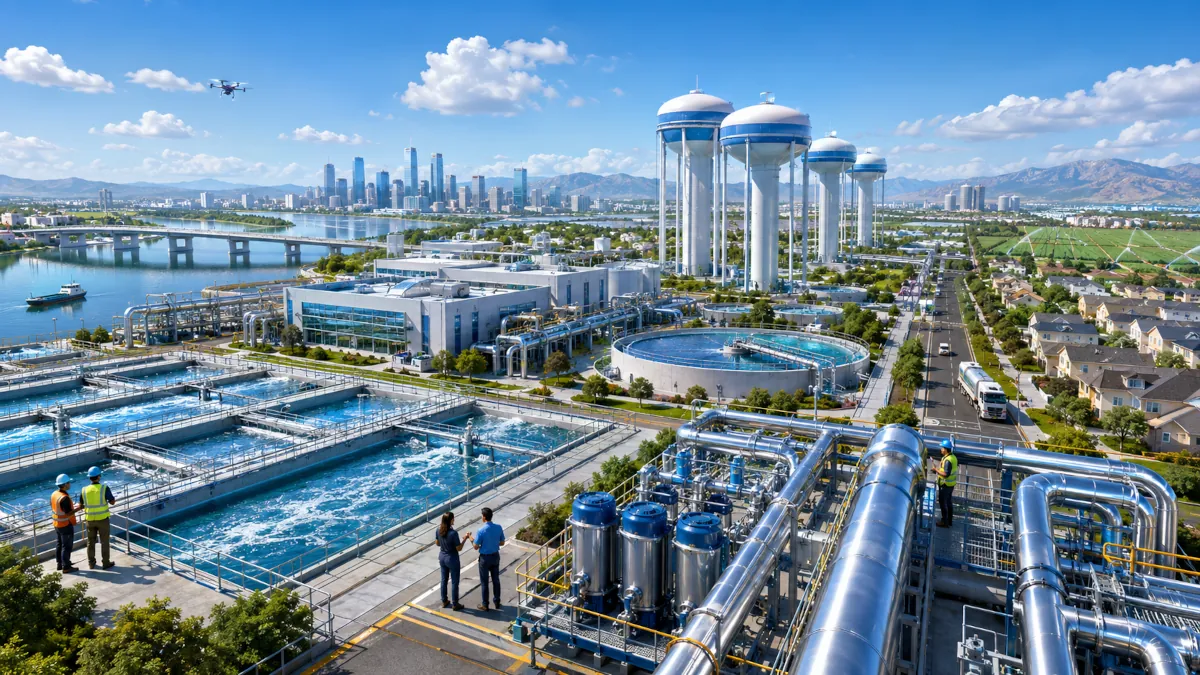
A growing body of operational evidence (Orange County, California; Salinas Valley; Eastern Virginia) demonstrates that the cheapest and fastest way to expand water capacity isn't to import from further away. It's to recycle within the metro area through advanced wastewater treatment combined with groundwater recharge.
The numbers are striking. Orange County's program meets approximately 75% of the drinking water needs of 2.5 million residents through wastewater recycling, groundwater recharge, and effluent-laden stream water. Salinas Valley runs a parallel model using municipal effluent, urban runoff, and food-processing wash water. Eastern Virginia uses aquifer recharge with treated wastewater to simultaneously protect Chesapeake Bay water quality and counter land subsidence. These aren't pilots. They are operational systems serving millions of people.
The technology stack (membrane bioreactors, reverse osmosis, UV-LED disinfection) is mature and the public health record is excellent. The reason every water-stressed metro doesn't run on this model is institutional inertia and local political resistance to "toilet to tap" framing, not engineering.
The politics shift in a predictable pattern, and it's worth naming because every metro is at a different point on the curve. Drought severity does most of the work. Orange County didn't get there in a vacuum, they got there after decades of supply pressure made the alternatives obviously worse. Public health transparency matters too, particularly multi-year operational data showing the recycled water meets or exceeds standards for conventional supply. And almost every successful program started with non-potable reuse for landscaping, industrial cooling, and groundwater recharge before moving toward direct potable reuse. The intermediate step gives the public a chance to see the system working without the framing problem getting in the way. The metros that wait for political consensus before starting the non-potable phase are the ones that arrive at the crisis with nothing operational.
The engineering case for retrofitting existing wastewater plants is now considerably stronger than the case for new long-distance import, and the DOE has begun directing R&D capital toward expanding the technology base.
The full 10x toolkit
Hyperscale recycling is the largest single lever, but it isn't the whole answer. A 10x water system is a portfolio.
| Strategy | Mechanism | Scaling potential |
|---|---|---|
| Hyperscale water recycling | Treat wastewater to potable standards; combine with groundwater recharge and stream reuse | Demonstrated 75% metro-scale self-sufficiency at Orange County; replicable across most U.S. metros |
| AI-powered leak detection | Acoustic sensors plus ML anomaly detection on existing distribution pipes | Reclaims meaningful share of the 6 billion gallons/day lost to leaks; effectively creates new capacity from existing assets |
| Advanced desalination | Brackish-water reverse osmosis (BWRO) and new ion-exchange membranes unlock vast inland saltwater aquifers, not just coastal seawater | Opens a new supply source for the inland U.S. at roughly one-third the energy cost of seawater desalination |
| PFAS treatment retrofit | Reverse osmosis at the treatment plant or building scale removes PFAS and algal toxins | Addresses the 25% of U.S. water supply currently contaminated by PFAS |
| LED UV disinfection and electrified treatment | Replaces chemical-handling steps with energy-efficient electric processes | Particularly attractive at small or distributed scale; reduces operational complexity and chemical supply risk |
| Point-of-entry and point-of-use treatment | Treat only the water that needs to be potable; separate streams for irrigation and cleaning | Lower total system cost; reduces pipe replacement urgency on legacy mains |
The three-pronged 10x roadmap
If I had to compress this whole picture into three actions:
- Deploy the Orange County hyperscale recycling model in every metro currently dependent on long-distance imports, with the Colorado River basin as the urgent first wave.
- Mandate AI-powered leak detection and operational analytics on every major distribution network in the country. Six billion gallons a day is too much treated water to keep losing.
- Federal investment in PFAS retrofit at the treatment plant scale, on the same urgency tier as lead service line replacement, with a coordinated funding mechanism that doesn't require 50,000 utilities to figure it out independently.
None of these are exotic. None of them require waiting on a breakthrough. They require deciding to do the work.
The obstacle is the way
There's a line from Marcus Aurelius that I find equal parts inspiring and terrifying. What stands in the way becomes the way. Ryan Holiday turned it into a book brand. I think it's actually a load-bearing observation about civilizations.
We tend to talk about water infrastructure as a dependency for economic growth. Something that has to be in place before the real economy happens. That framing undersells it badly. Water infrastructure isn't a dependency for wealth. It is wealth. The pipes, the treatment plants, the membrane facilities, the leak detection arrays, the recycling systems, all of it is wealth in physical form, and the act of building it is a generational transfer of jobs, trades, apprenticeships, and engineering capacity that doesn't come from anywhere else.
Veolia and the National Association of Water Companies put real numbers on this in their 2026 white paper. Replacement cost for U.S. water mains alone is about $452 billion. Every billion deployed supports roughly 28,500 jobs and generates about $2.50 in economic output, up to $4 on restoration work. The cost of standing still runs the other way. Veolia projects annual deterioration costs running about seven times current levels by 2039 if investment keeps lagging.
South Bend, Indiana is a small but useful proof point. The city spent $7 million on sewer sensors and analytics, cut overflow by more than a billion gallons a year, and is on track to save roughly $500 million in long-term capital costs. Multiply small wins like that across the $625 billion EPA backlog and you get an economic engine that runs for two decades, employs people in every state, and produces a more durable economy on the other side of the work than the one we have now. The construction is the prosperity. It always was.
I made the same case in the grid piece, and it's worth stating again here, because it's the position both papers exist to argue. Power and water modernization, taken together, is the largest domestic economic engine the U.S. has access to in this decade. The AI build-out itself is the third leg. Treated as co-investments rather than as load and constraint, power, water, and AI compound into a multi-decade growth story that doesn't depend on any single breakthrough. None of this would take a miracle, but it will take work.
Closing thoughts
I don't think communities fighting individual data center sitings are wrong. They've looked at their local utility's books, run the math, and concluded that the system genuinely can't absorb additional load. That's not NIMBYism. That's a diagnosis.
We can do better than wait for the next Flint to make the case. The tools are sitting on the shelf. The economics work. The labor force exists or can be trained, which is its own urgent problem given the retirement cliff inside the next ten years. PFAS is the contamination issue the public hasn't fully internalized, and it's the one where the engineering answer is the most settled and the policy response is the most stalled. What's been missing across all of it is the will to treat the water system as something worth being seriously good at again.
If you're working on this from any angle, utility side, vendor, civic, regulatory, environmental, or public health, I'd love to hear what's actually moving and what's still stuck. The companion piece on the grid is up. The larger article on AI's real cost will follow these two papers. The position needs to be visible while it's still useful.